Innovative ways contractors can manage cash flow, reduce costs and win more work during a recession (pt 4)
PART 4 OF 4: HOW DIVERSIFYING + WINNING NEW BUSINESS HELPS CONTRACTORS SUCCEED DURING A RECESSION
Before we get stuck in, let’s have a quick recap…
WHAT DOES THE FUTURE HOLD FOR CONSTRUCTION?
The truth is no one knows the future, but there is some guidance to help assist in commercial decision-making.
2022: Despite the uptick in insolvencies, 2022 saw construction output increase by 5.6% (compared to 2021). This rise was driven by new work (+3.8%) and repair and maintenance work (+8.5%).
2023: This year will be harder. The CPA (Construction Products Association) predicts that construction output will decrease by 4.7% this year.
Despite this slowdown, JP Morgan and others believe the wider UK economy will avoid recession but will still see slow/negative growth in the first two quarters of 2023.
2024: The CPA also predicts that construction output will recover by 0.6% in 2024.
WHAT’S THE PLAN?
The outlook doesn’t look great but it doesn’t look apocalyptic either.
The plan for most construction businesses will be to weather 2023 and make the necessary business adjustments to take advantage of the 2024 recovery.
WHAT CAN CONTRACTORS DO TO PROTECT THEIR BUSINESSES DURING THE DOWNTURN?
Despite the UK technically avoiding a recession, 2023 may still feel like one.
By all accounts, 2023 will be nothing like 2008 and will be further distinguished by the fact that goods, services and energy will remain expensive despite a decline in demand.
This means that traditional ‘belt-tightening’ and cost cutting won’t work. At least not in isolation.
In this series of blogs, we’ll be looking at innovative ways that construction businesses can reduce cashflow bottlenecks, reduce cost and position themselves to grow faster than ever in 2024.
We’ve identified three areas/practices which can help contractors achieve this.
- Free Issuing
- Good Design Management
- Diversify + Win New Business
This blog is going to focus on diversifying revenue and winning new business.
HOW CAN CONTRACTORS DIVERSIFY + WIN NEW BUSINESS?
The answer is a shift from new build to repair and maintenance.
The Office of National Statistics (ONS) has shown that last year’s 5.6% increase in construction output was driven by growth in repair and maintenance work, up 8.5%.
New work only increased by 3.8%.
Excluding 2021, this was the largest annual growth for R+M (repair and maintenance) since records began.
The ONS graph below shows that since 2020 R+M has been growing as a proportion of all construction work.

Granular data on the exact characteristics of the repair work is elusive, but there is a strong probability that the growth in R+M can be attributed to:
- The £300BN Energy Efficiency Upgrade/ Retrofit Revolution. We wrote a blog series on how contractors can take advantage of this generation opportunity, here.
- Office landlords converting existing offices into homes, due to low occupancy. Data from the Department for Levelling Up, Housing and Communities showed that 2,119 bids were made in 2021 to use permitted development rights to convert offices into homes.
- People working from home are investing the money they would have spent on commuting and leisure into adding value to their homes. This trend started in 2020 (due to covid) and has continued. In 2020, covid forced the UK public to save an additional £140Bn.
HOW DOES DIVERSIFYING AND WINNING NEW BUSINESS HELP DURING A RECESSION?
Recessionary and inflationary environments change consumer and commercial spending habits. People cut back and focus on essentials, but they don’t stop.
Subsequent recessions have shown that demand for repair and maintenance work increases as demand for new build work declines. 2023 is no different.
Repositioning your construction business to take advantage of this shift will keep the cash flowing during the lean times and supercharge revenue growth during recovery and boom.
APART FROM R+M WHAT ELSE CAN CONTRACTORS DO TO DIVERSIFY, REDUCE COSTS AND INCREASE REVENUES?
Use technology to streamline back-of-house processes:
One way to reduce costs without reducing productivity or capacity is to use technology to streamline your back-of-house/admin processes. One of the most resource-intensive parts of construction is the estimation of works and subcontractor tendering. Cloud-based platforms like C-Link allow you to supercharge this process.
- During Competitive Tendering: C-Link saves contractors up to 300-man hours, 6-man weeks or the equivalent of ~£7500 for every tender process (win or lose). These time and cost-savings stack up and allow contractors to pursue 8-10% more competitive tender opportunities, per year.
- During Full Subcontractor Tendering: C-Link is saves up to 600-man hours, 3.75 months or the equivalent of £15,000 (assuming 20 subcontractor packages).
- Across A Full Project (Inc competitive tender and subcontract tendering): Throughout a full project C-Link saves 900-man hours, 5.25 months of work or the equivalent of £22,500. Platforms like C-Link often cost a few hundred pounds a month but save tens of thousands of pounds in time, work, and mistakes.
New, more competitive subcontractors:
Another way to cut costs is to review subcontractor relationships and find more competitively priced firms that can be trusted.
This can be hard. The temptation to keep the same roster of subcontractors is strong because finding and pre-qualifying new subcontractors is time consuming.
Fortunately, platforms like C-Link offer main contracts access to thousands of pre-qualified and vetted subcontractors, all over the country. On average, C-Link customers save 5% on construction costs.
C-Link is so confident of their ability to save their customers money that, if you don’t save 5% against budget construction costs when you manage subcontract procurement with C-Link, we’ll give you your money back.
Retrofit Revolution:
As mentioned above, the £300BN Energy Efficiency Upgrade/ Retrofit Revolution is accelerating. This is most likely due to the imminent and significant shifts in energy efficiency legislation.
For rental housing:
- Under the current guidelines, landlords must ensure their properties have a minimum EPC rating of E before advertising & letting their property to tenants.
- By the end of December 2025, all properties accepting new tenancies across England and Wales must achieve a rating of EPC C or above.
- All existing tenancies must achieve an EPC- C rating by the end of December 2028.
For leased commercial property:
- The requirement for the EPC rating to be E or higher has been in place since 1 April 2020.
- Commercial properties must have an EPC rating of C or higher by 1 April 2027.
- Commercial properties must have an EPC rating of B or better by 2030.
These legislative changes create a countercyclical business opportunity for contractors.
With relatively modest repositioning, construction businesses could be filling their order books with energy-efficient retrofit work while waiting for new build demand to recover.
NetZero Energy Infrastructure (EPC Contractor Partnerships):
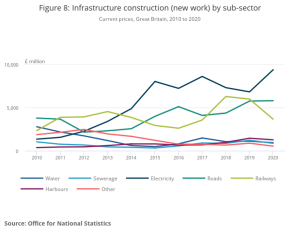
The ONS construction data also showed that the highest construction growth was in infrastructure. In 2022 infrastructure-focused construction grew by 29.5% compared to February 2020, and achieved a combined value of £2.4BN.
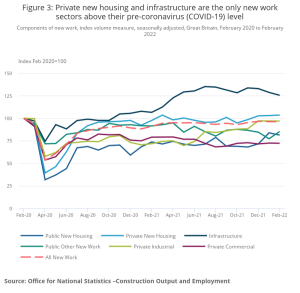
The greatest growth in infrastructure investment has been in electricity infrastructure. This growth is being driven by two things:
- An increase in electrical devices has forced improvement to the grid. UK Electrical demand is set to increase by ~50% by 2035.
- The energy transition to net zero. In 2021, PM Johnson set the national target for all British Electricity to be carbon neutral by 2035.
The best way for building contractors to take advantage of the huge amount of work in the electricity infrastructure space is to partner with EPC Contractors (Engineering, Procurement and Construction). EPC contracts function like design and build contracts, in the sense that they are fixed price and the main contractor subcontracts packages to other specialist contractors.
The appropriateness of this option will vary from business to business. Those that successfully forge a partnership with EPC Contractors will unlock a lucrative and countercyclical revenue stream that will continue to grow for at least 20 years.
HOW IS C-LINK HELPING CONTRACTORS COPE WITH THE DOWNTURN?
C-Link is working with leading construction businesses to streamline their most resource-intensive, time-consuming activity, estimation and sub-contract tendering.
On average C-Link is saving main contractors up to 900-man-hours per project.
(300-man hours during competitive tender and 600-man hours during sub-contractor tendering and management.)
If you’d like to discuss how C-Link can help you do the same drop us a note here.
If you’re not ready, but if you’re intrigued, why not check out our platform?